

Train to Research Objectives
REALISE is an MSCA Doctoral Network that will train 15 Doctoral Candidates to become next-generation Earth scientists and entrepreneurs, capable of developing innovative strategies for petrological data collection, modeling, and interpretation. The project focuses on key questions regarding the physical, thermodynamic, and chemical evolution of magmatic feeding systems, the enrichment and segregation of critical elements from magmas, and the emplacement of magmas and critical-element–bearing bodies at different crustal levels.
State-of-the-art
Explosive volcanic eruptions are the extreme outcome of magma’s lifecycle. While they unleash significant damage, magmas are not solely destructive. They also provide us with many critical raw materials that are of paramount economic and societal importance. In both cases, unravelling the processes and dynamics occurring in magmatic feeding systems is a mandatory, but challenging, and sometimes frustrating task. This is because the processes and dynamics occurring within magmatic systems are non-linearly related and span a wide range of spatial (from nm to km) and temporal (from seconds to ky) scales. Embracing innovative approaches, based on methods that go beyond the state-of-the-art, is pivotal to unlocking many fundamental questions concerning processes and dynamics occurring in fossil or active magmatic feeding systems.
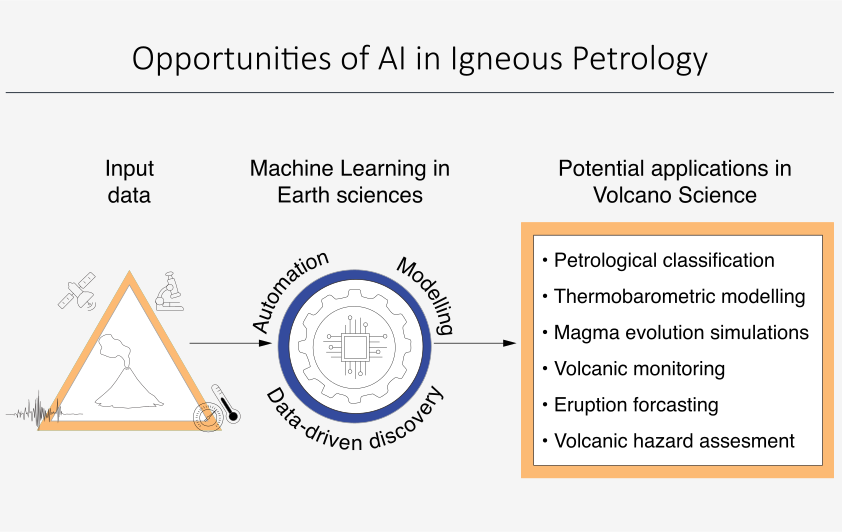
Fundamental topics include the genesis of magmas, the origin and evolution of melts and fluids, the definition of storage conditions in trans-crustal volcanic plumbing systems, the dynamics driving the formation of intrusive bodies or leading to eruptions, and eruptive style modulations. Moreover, research on these topics leads to discoveries of the processes and dynamics that govern the segregation and formation of fertile mineral deposits of critical raw materials such as Lithium, Platinum Group Metals, and Rare Earth Elements. Nevertheless, disclosing chemical and thermodynamic processes that govern the segregation and the emplacement of ore deposits containing critical elements from magmas is currently a hot topic and a challenge (European Critical Raw Materials Act, 2023 ). Machine learning (ML) has gained traction and has led to paradigm shifts in many research fields, including medicine, the industry of mobility, the internet of things, and precision agriculture. Also, ML algorithms have been successfully applied to Earth Science problems, including petrology. Nowadays, we are experiencing a surge of scientific contributions that involve ML techniques in many fields of the Earth Sciences. At the same time, the application of ML techniques in Earth Sciences is often followed by strong debates, dealing with both the methodological approach and the following interpretation. Many Earth Scientists still consider them ‘Black-Boxes’.Moreover, as reported by Fleming et al.: “Every modelling framework has its own philosophy, theory, nomenclature, implementation details and culture of practice – and the proportion of geoscientists with expertise in new AI technologies and concepts, and particularly in how to use and interpret this new class of scientific tool, remains very limited”.
Scientific Goals
The overarching scientific goals of the REALISE research programme are:
(1) Improve hazard evaluation and risk mitigation strategies related to volcanic events; (2) Improve our knowledge about genetic mechanisms leading to the segregation and emplacement of magma-related critical raw materials fertile deposits.
Working Packages
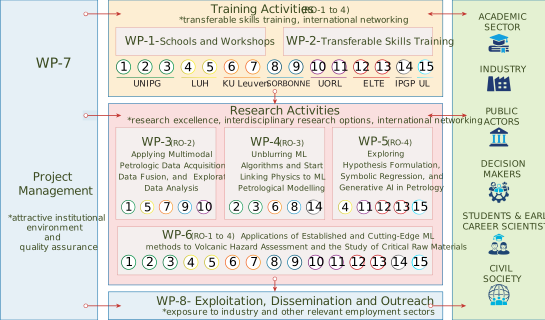
To achieve these goals, DCs will be systematically trained (WP1 and WP2) and they will engage in research within Individual Research Projects working towards four pivotal Research Objectives (ROs), which serve as the foundations for REALISE’s scientific Work Packages (WP3 to WP6):
RO1: Systematically investigating the use of established ML techniques to illuminate the lifecycle of magmas, shedding new light on age-old questions (all DCs are involved at training and research level).
RO2: Fusing complementary information derived from cutting-edge analytical techniques to gather unprecedented petrologic data (DC1, 5, 7, 9, 10).
RO3: Bridging the gap between physics and ML in petrological modelling to develop ground-breaking computational flow dynamics and atomistic simulations (DC2, 3, 6, 8, 14).
RO4: Exploring the potential of Generative AI, Hypothesis formulation, and Symbolic Regression in petrological studies (DC4, 11, 12, 13, 15).